> For the complete documentation index, see [llms.txt](https://docs.cyphernet.io/llms.txt). Markdown versions of documentation pages are available by appending `.md` to page URLs; this page is available as [Markdown](https://docs.cyphernet.io/cyphernet.md).
# Cyphernet
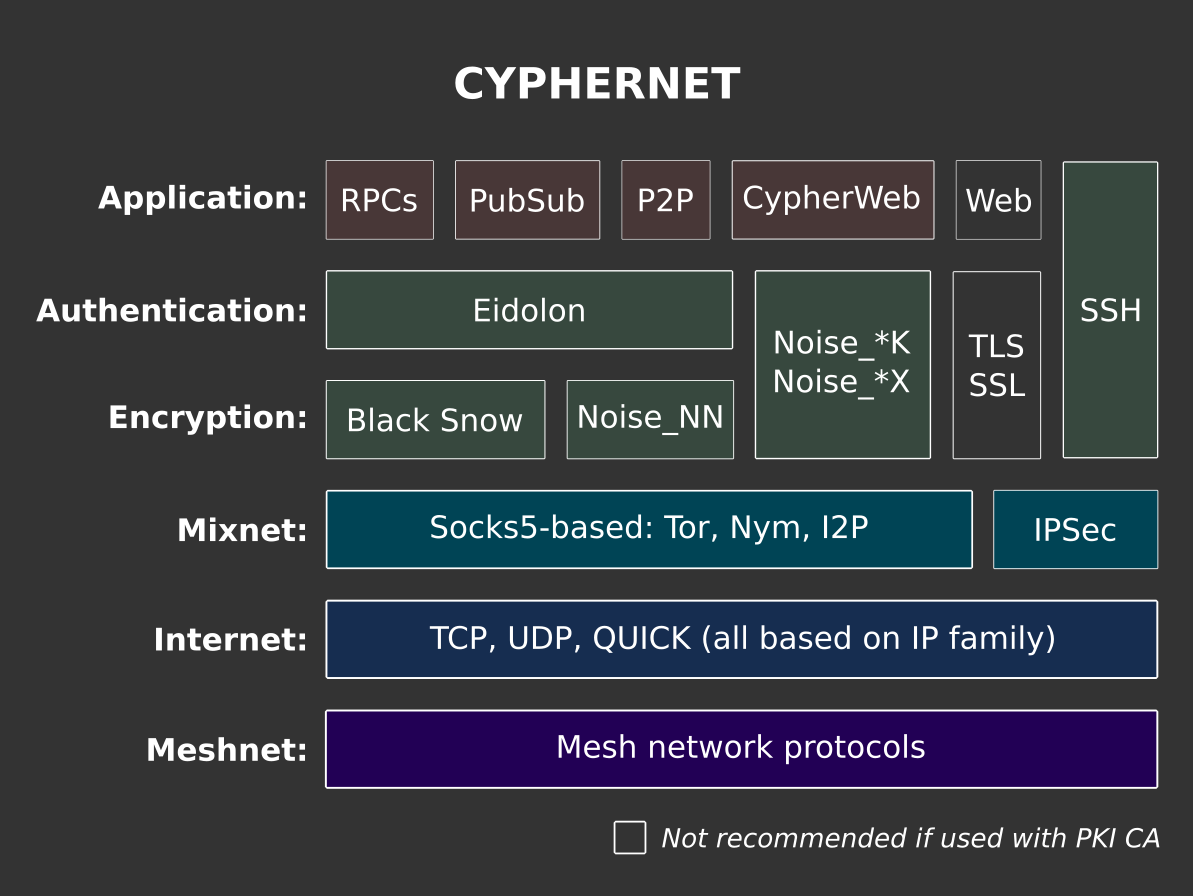
Cyphernet stack consists of the following layers:
1. Meshnet: the base physical connectivity layer
2. Internet: routing and transport between connected meshnets / physical networks
3. Mixnet: a layer on top of internet which hides actual routing information and makes it indistinguishable from the background activity and noise
4. Encryption: layer which guarantees that all the layers below doesn't have access to the data delivered in the messages
5. Authentication: an optional layer guaranteeing that the parties connected through the layers below can recognize each other and maintain long-term relationships based on reputation, which may persists longer than a single connection
6. Application
Internet consists of IP protocol, related routing protocols and transport-level protocols, like TCP, UDP, QUICK, and others.
Mixnet can be either a simple proxy or virtual private network protocols, like SOCKS5 and IPsec, or protocols which does the actual mixnet, like Tor, I2P and Nym.
Encryption can be a PKI-based, which can't be seen as a part of cyphernet, or WoT-based. The specific existing technologies for the encryption include SSL, TLS, SSH and recent Noise protocol suite, however all of them are both authentication and encryption protocols, not separating layer 4 and 5. As a result the require an identity infrastructure, and in the most of cases it is PKI (as with SSL and TLS), or an absence of infrastructure, like in SSH and Noise protocols.
Recent activity has been focused on separating authentication from the encryption. The pioneer in this sphere is a new Bitcoin P2P protocol defined in BIP\_\_\_. In Cyphernet Initiative we try to define a new applciation-agnostic authentification protocol based on WoT-like identities (codenamed Eidolon), clearly distinguished from the encryption protocol layer - which, in turn, doesn't provide a required authentification - codenamed Black Snow.
## Black Snow (BSNC)
"You know nothing, John Snow"
---
# Agent Instructions
This documentation is published with GitBook. GitBook is the documentation platform designed so that both humans and AI agents can read, navigate, and reason over technical content effectively. Learn more at gitbook.com.
## Querying This Documentation
If you need additional information that is not directly available in this page, you can query the documentation by asking a question.
Perform an HTTP GET request on the following URL with the `ask` and `goal` query parameters:
```
GET https://docs.cyphernet.io/cyphernet.md?ask=&goal=
```
`ask` is the immediate question: it should be specific, self-contained, and written in natural language.
`goal` is what the user is ultimately trying to achieve, the reason they need the answer. Sharing it helps GitBook give you a better, more relevant answer. A goal is most helpful when it describes the outcome the user wants rather than restating the question. For example, with `ask=how do I create an API token`, a goal like `automate deployments from our CI pipeline` lets GitBook tailor the answer to that use case.
The response will contain a direct answer to the question and relevant excerpts and sources from the documentation.
Use this mechanism when the answer is not explicitly present in the current page, you need clarification or additional context, or you want to retrieve related documentation sections.